
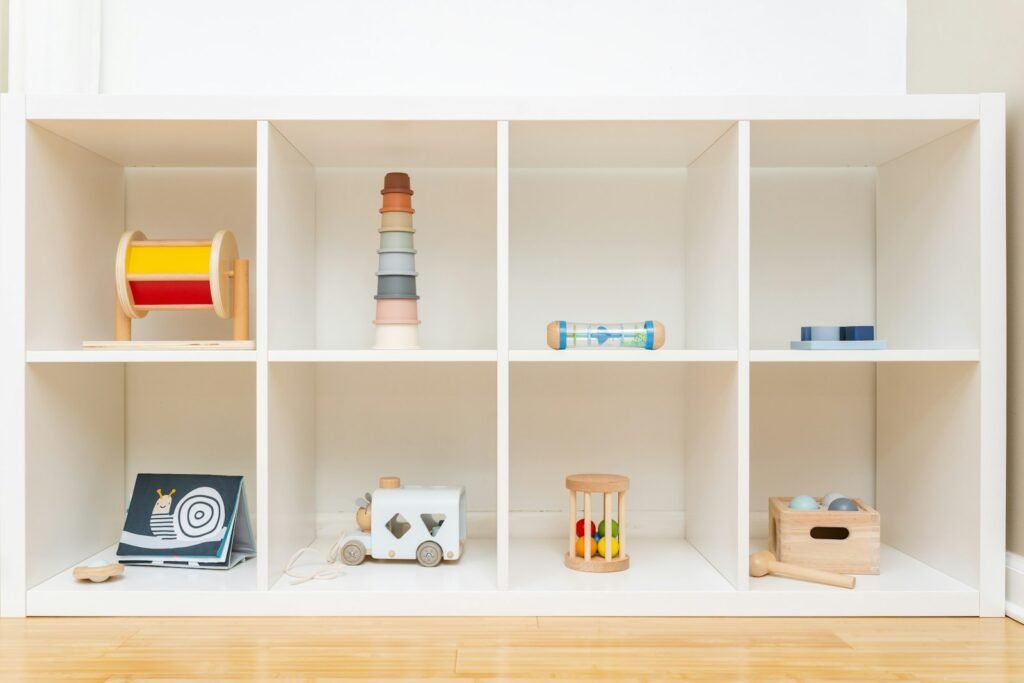
When people hear “Montessori”, they often picture beautiful wooden materials and expensive classrooms. I understand. When I first started weaving Montessori ideas into our homeschool, I thought I needed shelves full of special equipment too. I didn’t. What I needed was a different way of looking at my children.
Montessori at home is less about what you buy and more about how you set up your space, how you step back, and how much you trust your child to do things for themselves. In this guide I’ll share the principles that matter most, simple activities by age, and how we use Montessori ideas as one part of a blended, child-centred homeschool in Hong Kong.
It’s part of my wider guide to gentle homeschooling in Hong Kong.
What is the Montessori approach?
The Montessori method was developed by the Italian physician and educator Maria Montessori in the early 1900s. Her central idea was that children are naturally driven to learn, and that adults should prepare an environment where that drive can flourish, rather than direct every step.
The principles I return to most are:
- Follow the child. Observe what your child is drawn to and ready for, and offer activities that meet them there.
- Independence. “Help me to do it myself” is the heart of Montessori. Children gain confidence when they can do real tasks on their own.
- A prepared environment. An orderly, accessible space where everything has a place and children can choose their own work.
- Hands-on learning. Concrete materials before abstract ideas: counting real objects before writing numbers.
- Uninterrupted focus. Long stretches of time to concentrate, without constant adult interruption.
- Respect. Treating children as capable people whose work matters.
Setting up a Montessori-friendly space at home
You don’t need a dedicated room. Hong Kong flats are small, and our “Montessori corner” has always been modest. What matters is that it’s accessible, simple and orderly.
- Low, open shelves your child can reach without help
- Fewer choices, displayed clearly. Six to eight activities on a shelf, each on its own tray or in its own basket, rather than a toy box full of everything
- Rotate activities every week or two, based on what you observe your child enjoying or mastering
- Child-sized tools: a small jug, a real (child-safe) knife for soft foods, a little broom and dustpan
- A step stool in the kitchen and bathroom so children can help and wash independently
- Hooks at child height for bags and coats
The aim is a home where your child can find what they need, use it, and put it back without asking for help.
Simple Montessori activities by age
Always supervise young children with small objects, and choose materials suited to your child’s age and stage.
Toddlers (around 18 months to 3 years)
- Pouring and transferring: pouring dry rice or beans between two small jugs, then water once they’re confident
- Posting and fitting: dropping large objects into a box with a hole cut in the lid
- Practical life: wiping the table, putting shoes away, helping carry groceries
- Naming objects: a basket of real household objects to touch and name
Preschoolers (around 3 to 6 years)
- Food preparation: peeling a mandarin, slicing a banana, spreading butter
- Sorting and matching: sorting buttons by colour or size, matching pairs of socks
- Sensory work: a “mystery bag” of objects to identify by touch
- Early maths: counting real objects such as shells or pebbles collected outdoors
- Early literacy: tracing letters in a tray of sand or salt
- Caring for plants: watering, wiping leaves, planting seeds
School-age children (6 and up)
Montessori doesn’t stop at preschool. For older children, the emphasis shifts to research, reasoning and big questions:
- Research projects led by the child’s questions: “Why do typhoons spin?” “How did people in Hong Kong get water before reservoirs?”
- Timelines of history, of life on Earth, or of the child’s own life
- Hands-on maths with real measuring, cooking, budgeting and building
- Real responsibilities: planning a family meal, organising an outing, caring for a pet
- Nature study and observation journals
This is where Montessori blends naturally with project-based learning and our time outdoors. If you love that side of things, read my post on nature-based learning in Hong Kong.
Your role: observe, prepare, step back
The hardest part of Montessori for me was learning to not help. When my child struggled to pour, my instinct was to take the jug. Montessori asks you to wait, to show slowly and clearly, and then let them try again.
- Observe. Spend a few minutes each day simply watching what your child chooses and how they work.
- Demonstrate slowly. Show a new activity with slow, deliberate movements and few words.
- Step back. Let them practise, repeat and make mistakes.
- Protect concentration. When a child is deeply focused, don’t interrupt, even to praise.
- Treat mistakes as information. A spill is a chance to learn to clean up, not a failure.
Montessori and emotional wellbeing
One reason Montessori fits so well in our home is how much it supports a child’s sense of calm and capability. Predictable order, real choices and the satisfaction of doing things independently build confidence. For a child who has felt anxious or overwhelmed, that sense of “I can do this” matters enormously. I write more about this in supporting an anxious child through learning at home.
Montessori on a budget
- Use real household items rather than buying special materials.
- Collect natural objects such as shells, leaves and stones on walks.
- Make your own matching cards from photos or magazine pictures.
- Look for second-hand shelves and trays. Hong Kong’s online marketplaces are full of them.
- Borrow books on Montessori from the public library before buying.
Frequently asked questions
Do I need special Montessori materials at home?
No. Many of the most valuable Montessori activities use ordinary household items: jugs, trays, cloths, food, plants and natural objects. Organisation and access matter more than buying specific materials.
What age is Montessori for?
Montessori principles can be used from infancy through the teenage years. The activities change with age, but the ideas of independence, respect and hands-on learning stay the same.
Can I combine Montessori with other homeschooling approaches?
Absolutely. Our family blends Montessori with project-based learning, nature study and lots of reading. Use what helps your child and leave what doesn’t.
How long should a Montessori activity last?
As long as your child is engaged. Some children repeat an activity for a long time, which is a sign of deep concentration. Avoid interrupting, and let them choose when to finish.
Is Montessori too unstructured?
Not at all. It’s highly structured, but the structure lives in the environment and the routine rather than in constant adult direction.
Start with one shelf
You don’t need to transform your home overnight. Clear one low shelf, put out a few simple activities, and watch what your child does with them. That small change is often all it takes to see how capable children are when we give them the chance. For more on how we bring it all together, read my guide to homeschooling in Hong Kong.